
Last Tuesday, I sat down to write a challenging email.
I suddenly noticed that I hadn’t watered the plant across the room recently. Forty-five minutes later, I was still puttering around my house making sure all my plants were happy. Yes, I have a lot of plants (just ask my husband), and yes, taking care of them is important.
Really, though, you and I both know the urge to take care of them in that moment was pure distraction – while the thing I’d been avoiding (a difficult conversation) sat quietly in the background, waiting.
Sound familiar?
We are masters at not feeling things.
Doom scrolling. Staying perpetually busy. Pouring another glass of wine. Saying “I’m fine” so many times we almost believe it.
We’ve built entire lifestyles around the art of avoidance. So much so that we don’t even notice we’re doing it, and more importantly, we don’t notice what it’s doing to us.
Let’s address this and make some shift happen.

The Beach Ball Problem
Here’s the thing about avoidance – it doesn’t make the thing we’re avoiding go away, it just stuffs it down someplace within us. We know this, and we still do it because it puts it out of sight for a moment and stops making us uncomfortable.

It’s like taking a beach ball and pushing it underwater. You sit on it, hold it down, and for a moment — relief. It’s gone. You can’t see it anymore.
Then someone tosses you another beach ball. And another. And you’re sitting there, arms shaking, trying to hold them all down at once… until one slips. Then another. And suddenly they’re flying up everywhere, hitting people, making a mess.
That’s the moment you snap at your partner over something small. That’s the migraine that won’t quit. The shoulder that’s been “a little stiff” for two years. The stomach that’s always just off.
Those aren’t random. Those are beach balls.
In this week’s episode of The Soulful Leader Podcast, Stephanie and I take this even further by looking at a truth that our culture generally ignores: the symptom is never the cause.
John Barnes, the myofascial release pioneer who trained Stephanie, taught her this early on. When someone comes in with shoulder pain, don’t just treat the shoulder. Back up. Look at the whole picture. The symptom is showing up in the shoulder — yet the cause is somewhere else entirely.
The same is true for your life.
Can’t sleep? Gaining weight? Constant low-grade anxiety? Those are road signs. First a yield sign. Then a stop sign. Then a stoplight. And if you keep ignoring them… eventually the stoplight falls on you.
The thing is, it’s actually easier to heed the road sign than have the stoplight fall on you.
So if the symptoms aren’t the problem… what is?
“This being human is a guest house. Every morning a new arrival — a joy, a depression, a meanness, some momentary awareness comes as an unexpected visitor. Welcome and entertain them all.”
— Rumi, The Guest House
The Part We Skipped
Here’s what Stephanie shared in the podcast that I find fascinating — and a little heartbreaking.
Somewhere along the way, we got divided up. Medicine took the physical body. Psychology took the mind. Religion took the soul.
It seems nobody wanted the emotions.
They got left on the table like that strange item at the potluck no one wants to touch.
And yet, emotions are the key, the connective tissue. They not only weave everything else together, they give power to our creations. They are the actual manifestors in our lives, the drivers behind what we create, tolerate, and find ourselves repeating.
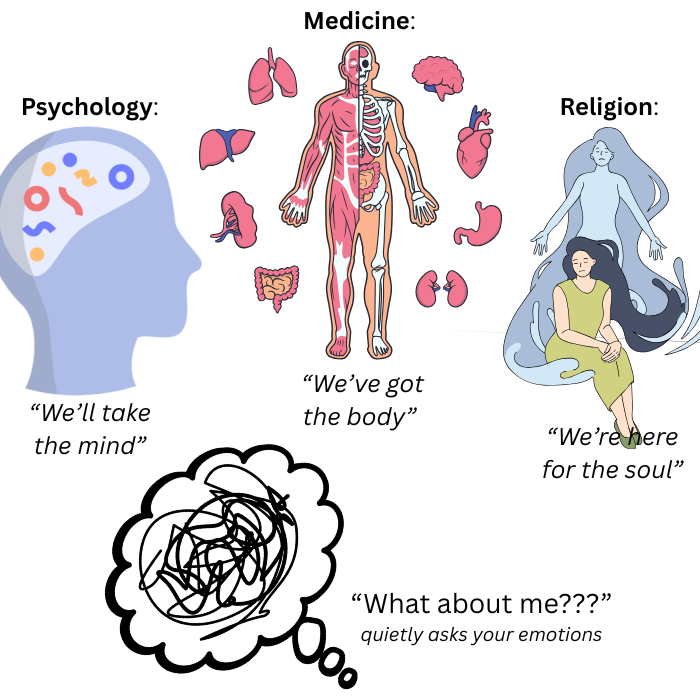
Emotions are literally energy in motion. When we stuff them, we don’t stop the energy, we subvert it. That means we lose control of where that energy goes.
That energy is now in the trunk. It’s throwing a party back there. Inviting all its friends. Meanwhile, you’re up front, white-knuckling the steering wheel, wondering why the ride feels so bumpy.
Learning to take back your power by actually getting to know your emotions, is one of the fastest ways to heal your symptoms – and your life.
The Weekly Challenge
This one is simple. It might also be the hardest thing you do all week.
For this week: Each time an emotion comes up — frustration, sadness, anxiety, even joy — instead of judging it, pushing it away or immediately trying to fix it, just say this:
A part of me is experiencing ___.”
That’s it.
Not “I am angry.” Instead “a part of me is experiencing anger.”
Notice what shifts. It opens a layer of space between you and the feeling.
You are not your emotion — how do you know? Because you’re the one noticing it. When you no longer identify as the emotion, you have a choice. You can step back. You can be curious about it. You can let it move through instead of getting stuck.
You don’t have to fix it. You don’t have to figure it out. You just get to let it be there for a moment.
As Rumi said, it may be clearing you out for some new delight.
Your “Next” Is Calling
The beach ball doesn’t disappear when you push it down, It also requires ongoing energy to hold it below the surface.
When you stop fighting it — it just floats.
And when you stop fighting yourself… everything changes.
——–
Want to go deeper on this? Listen to Episode 205 of The Soulful Leader Podcast — we unpack all of this and more. And if this resonated, subscribe to Shift Happens, our weekly newsletter with tools and insights to help you lead from the inside out.
When you stop fighting it — it just floats.
And when you stop fighting yourself… everything changes.
Would you like help putting this into action so that you feel more resilient?
Check out our Inner Mastery Series.
For more information, click here.
When you care for yourself,
your mind, your body, your peace,
success starts flowing naturally.